Demand For Autonomous Bus Doors To Rise Post-Pandemic
9 Jul
2020
In 80’s movies, actors would use autonomous cars while catching criminals and could talk to the vehicles to move around traffic. Those movies would be regarded as based on futuristic ideas. It’s safe to that we are in the future portrayed in those movies.
Complete autonomy. These two words have driven several tech-giants in Silicon Valley. Companies such as Tesla are working on several fronts to improve the transportation sector as we know it. Investing in electric cars, hyperloops, and autonomous vehicles are some examples. Soon, there will be a day when instead of owning a car, we would prefer to hail a cab or bus that is driven by without drivers and run on electricity and creating zero carbon pollution.
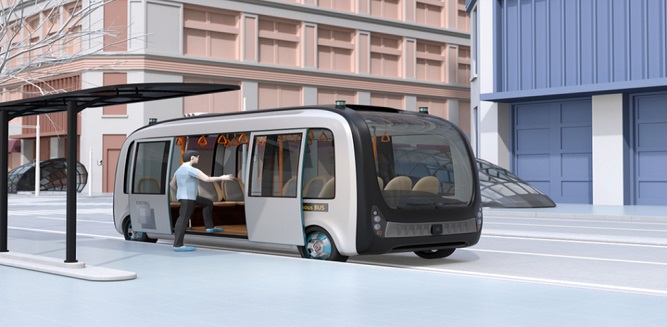
The concept of autonomous buses is not so futuristic now. The automotive company, Mercedes-Benz is way ahead of the curve. The company has already unveiled the Future Bus, which is capable of driving itself. The innovations such as this are responsible for the growth of the supplementary markets such as autonomous bus doors systems industry. According to Allied Market Research, the industry is expected to garner $77 million by 2027, growing at CAGR 43.8% from 2020 to 2027. The integration of autonomous bus doors would witness a significant demand as people opt for contactless option due to outbreak of Covid-19. Thus, the global market for autonomous bus doors is expected to increase post-pandemic.
Mercedes’ Future Bus uses CItyPilot technology to identity traffic signals and interact & negotiate with such signals. The bus could stop at the designated bus stops automatically and open & close gates for passengers. Moreover, the technology is fully capable of obstacles and people on the streets and apply breaks automatically to avoid collision. In order to do this, the CityPilot uses dozens of cameras for scanning the road and surrounding and the integrated GPS helps develop images to position the bus when the bus stop approaches.
Apart from this, the outbreak of Covid-19 has greatly impacted the autonomous bus door system technology. During such trying times, people realized how major public transportation systems are completely dependent on humans. However, to avoid the risk of infection, companies had to come up with innovations to continue public transportation. For instance, Mercedes has offered a professional retrofit solution for driver protection door with separating pane for its city bus.
The pandemic has increased the demand for autonomous buses, taxis, and cars. In addition, the potential for such transportation alternatives is high in expanding urban areas with growing population as such vehicles can operate at very low maintenance cost compared to underground network services. The driverless cars operate at low cost and reduce to total expenditure by more than 50% and investment is lower than the investments on developing underground networks.
On the other hand, the need to reduce traffic congestion, rise in demand for fuel-efficient and low-emission vehicles, and development of smart cities are the major motives for the increasing demand for autonomous vehicles. The autonomous buses are a sustainable solution for reducing traffic congestion as well as an eco-friendly mode of transportations. Thus, in the future, people will demand driverless buses more than ever.Â

Koyel Ghosh
Author’s Bio- Koyel Ghosh is a blogger with a strong passion and enjoys writing in miscellaneous domains, as she believes it lets her explore a wide variety of niches. She has an innate interest in creativity and enjoys experimenting with different writing styles. A writer who never stops imagining, she has been serving the corporate industry for the last five years.
Avenue: Entire Library membership of Allied Market Research Reports at your disposal
- Avenue is an innovative subscription-based online report database.
- Avail an online access to the entire library of syndicated reports on more than 2,000 niche industries and company profiles on more than 12,000 firms across 11 domains.
- A cost-effective model tailored for entrepreneurs, investors, and students & researchers at universities.
- Request customizations, suggest new reports, and avail analyst support as per your requirements.
- Get an access to the library of reports at any time from any device and anywhere.
Related Post

Share on Social Media


-
How are Submarine Cables Transforming Global Connectivity with Enhanced User Experience?
-
Endoscopy Procedures: Transformations in Techniques and Applications
-
AI-Powered Video Analytics: How the Product Actually Works for enterprises
-
Painting Robots: Transforming Precision Coating and Creative Applications
-
Innovations in Pharmacovigilance Systems Advancing Patient Safety
-
Understanding Edge Security: Keeping Data Safe Near the Source
-
Exploring the Use and Advancements of 3D Laser Scanners in Professional Applications
-
Reinforcing Industrial Controls with Smarter Tools and Training